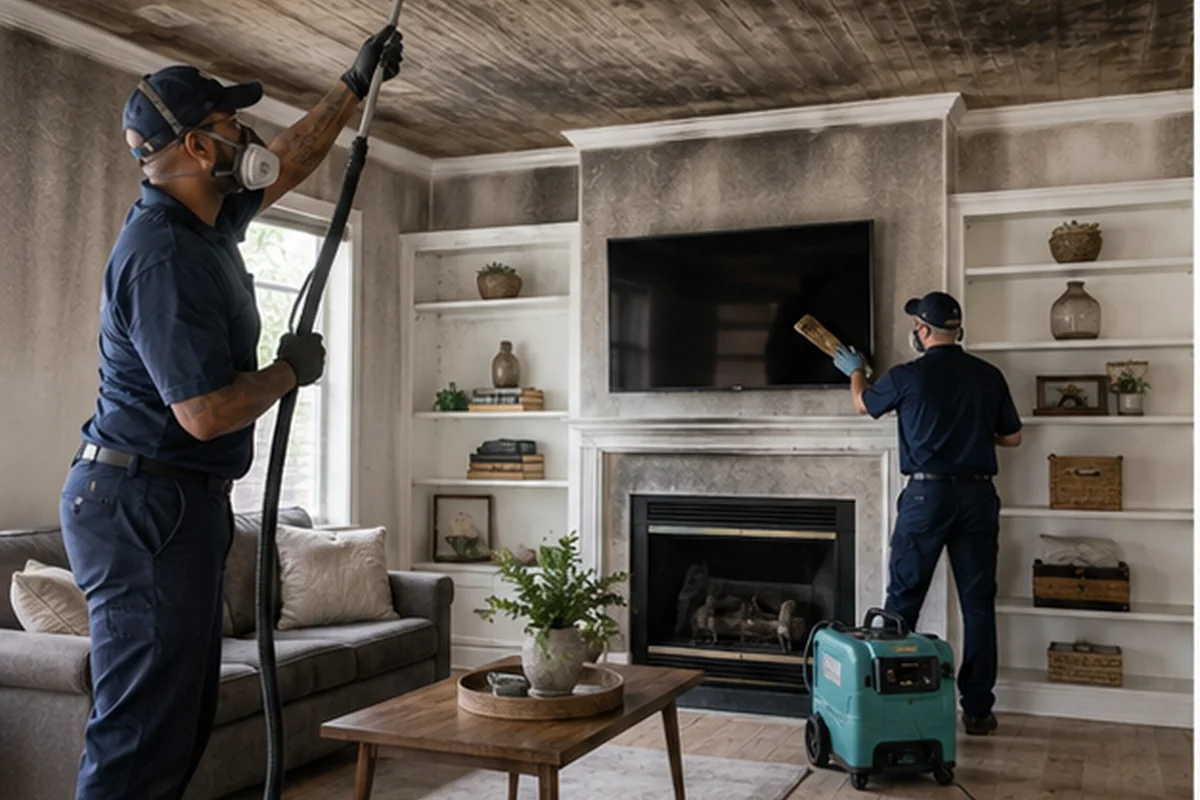
Fire and Smoke Restoration Jacksonville Intake
- Exact Jacksonville address and ZIP
- Source and active-water status
- Affected rooms, levels, and materials
- Water condition, sewage, electrical, or structural concerns
- Discovery time, prior actions, access, and safe photographs
Jacksonville Fire and Smoke Damage Restoration Coordination commercial request and restoration decision
Fire and Smoke Damage Restoration Coordination in Jacksonville requires an authority and safety boundary before residue or water damage work begins. A useful request records the exact Jacksonville address and ZIP, property type, affected floors and rooms, source or suspected source, whether water remains active, time discovered, visible material changes, odor, occupancy, utilities, prior actions, and safe photographs. Those details improve routing, but they do not classify water, diagnose hidden damage, prove mold, establish a price, or promise that a material can remain before a qualified site review.
TideMark Restoration treats the first call as the beginning of a drying journal rather than a sales shortcut. The customer should be able to follow the reported condition into a room map, material map, selected tests, written work boundary, equipment plan, monitoring record, and closeout. For this topic, the intake emphasizes authority-approved access, fire, smoke, soot, and suppression-water zones, structural, electrical, and regulated-material limits, and contents, cleaning trials, and reconstruction roles. The commercial decision follows observable evidence and clearly assigned responsibilities instead of a generic package built around fear or urgency.
- Exact Jacksonville address and ZIP
- Source and active-water status
- Affected rooms, levels, and materials
- Water condition, sewage, electrical, or structural concerns
- Discovery time, prior actions, access, and safe photographs
Jacksonville Fire and Smoke Damage Restoration Coordination source control and safe site access
Restoration cannot correct an active pipe, appliance, roof, drain, HVAC, exterior opening, or structural source unless that work is expressly included and performed by the appropriate qualified provider. The journal should identify whether the source is stopped, temporarily controlled, still unknown, or assigned to another party. If water can continue entering, the mitigation scope should state how that uncertainty affects access, equipment, monitoring, and the risk of additional affected materials.
People should stay away from wet electrical components, unstable ceilings, sewage, unknown water, damaged floors, fire residue, and areas restricted by authorities or property management. A safe accessible shutoff may be used by an appropriate person, but online content is not an instruction to enter a hazardous space or dismantle equipment. The inspection record should name unavailable utilities, access restrictions, suspected regulated materials, and any separate safety evaluation required before extraction, air movement, demolition, or cleaning.
- Source status and responsible repair party
- Wet electrical and unstable-material boundary
- Water condition and access restriction
- Separate qualified-trade referrals
Jacksonville Fire and Smoke Damage Restoration Coordination water condition, contamination, and containment
Water condition affects PPE, containment, cleaning, material retention, disposal, and whether air movement is appropriate. A newly released clean supply source, appliance discharge, exterior intrusion, unknown water, sewage, or water that has crossed contaminated materials cannot be treated as identical. Conditions can also change with time and contact. Remote photographs and customer descriptions help triage, but field observations and applicable professional standards govern the project-specific classification.
Containment should match the actual pathway rather than operate as decoration. Doors, pressure relationships, HVAC connections, floor transitions, traffic, debris routes, contents movement, and occupied spaces can carry moisture or contaminants beyond the visible boundary. Fans should not be started merely because air movement is associated with drying; source condition and contamination must be considered first. The written scope should explain restricted zones, protection, work paths, cleaning steps, and the condition required before barriers or controls are changed.
- Document the observed water and contact pathway
- Protect occupants and unaffected rooms
- Control debris, tools, and contents movement
- Authorize air movement only after site review
Jacksonville Fire and Smoke Damage Restoration Coordination moisture map and affected material layers
A stain or puddle is not a complete moisture map. Water can move beneath flooring, behind baseboards, through insulation, under cabinets, along framing, across concrete, and between units or levels. For this topic, material review may include drywall and insulation, flooring and subfloor, cabinets and millwork, and contents and HVAC-adjacent assemblies. The journal should use stable room names, wall or floor references, photographs, instrument type when relevant, and comparison points so later readings can be understood rather than presented as isolated numbers.
Moisture instruments support decisions only within their intended use and material context. Pin, non-invasive, thermo-hygrometer, infrared, and other observations answer different questions and may require confirmation. The record should distinguish a screening indication from a quantitative reading and identify inaccessible layers. Material appearance alone cannot prove dry conditions, while one elevated indication cannot automatically prove that every layer must be removed. Trends, integrity, contamination, access, and project criteria belong together.
- zone and residue photographs
- surface and material inventory
- representative cleaning trials when appropriate
- contents and handoff records
Jacksonville Fire and Smoke Damage Restoration Coordination drying in place and controlled removal scope
Drying in place can be a reasonable option when the source is controlled, water condition and material type permit retention, the assembly remains serviceable, wet layers are accessible to the drying strategy, and measurable response supports the plan. Controlled removal becomes appropriate when contamination, delamination, loss of integrity, trapped wet layers, access requirements, regulated-material restrictions, or failure to progress makes retention unsuitable. The proposal should connect either choice to specific rooms and materials.
For this service, a written scope may include site protection, suppression-water mitigation, controlled residue cleaning, contents handling, odor-control steps, documentation, and reconstruction handoff. Each line should name quantity or boundary, protection, access, equipment, cleaning, contents, debris, monitoring, and the trigger for a change order. Plumbing, roof, electrical, HVAC, structural work, hazardous-material services, mold assessment, laboratory work, finish replacement, cabinetry, flooring installation, painting, and insurance decisions remain separate unless the agreement explicitly assigns a qualified provider and deliverable.
- site protection
- suppression-water mitigation
- controlled residue cleaning
- contents handling
- odor-control steps
- documentation
- reconstruction handoff
Jacksonville Fire and Smoke Damage Restoration Coordination equipment plan and drying journal
Equipment should be selected and positioned for the actual rooms, volume, wet materials, containment, power, temperature, humidity, air pathways, and operating limitations. Air movers, dehumidifiers, extraction tools, filtration devices, or specialty systems are not evidence of progress by themselves. The plan should state what the equipment is intended to influence, where monitoring occurs, how cords and discharge are managed, and which occupancy or noise limits the customer must understand.
The drying journal connects date and time, ambient conditions, representative material locations, equipment changes, source status, access events, customer decisions, and unusual observations. Missing access, power interruption, re-entry of water, closed doors, moved equipment, new odors, or demolition decisions can explain a trend and should be recorded. A fixed number of days should not be promised before material response is measured. Completion follows supported criteria and the actual written scope, not an arbitrary calendar label.
- Named equipment purpose and location
- Repeatable room and material reading points
- Daily changes, access, and interruptions
- Documented completion or escalation criteria
Jacksonville Fire and Smoke Damage Restoration Coordination mold assessment and remediation role boundary
Moisture correction is central to preventing and addressing mold conditions, but water restoration and mold-related services are not interchangeable labels. Florida regulates individual mold assessors and mold remediators. Customers should verify the actual license record, individual role, company relationship, protocol responsibility, exemptions, and current status through official sources before authorization. A website brand or advertisement is not proof that every person or service is legally qualified.
Florida conflict restrictions can limit an assessor, remediator, or their company from performing both services on the same structure within the statutory period, subject to specific exceptions. The actual project and parties must be checked rather than summarized into a universal slogan. The scope should identify who assesses, who writes or adopts the remediation protocol, who remediates, who performs post-remediation evaluation when applicable, and who reconstructs. No mold-free, sterilization, health, or universal clearance promise belongs in the contract.
- Verify the individual Florida license and role
- Check assessor and remediator conflict boundaries
- Name protocol and post-remediation responsibility
- Avoid health, mold-free, and sterilization promises
Jacksonville Fire and Smoke Damage Restoration Coordination restoration cost and written proposal comparison
Restoration price depends on the source and water condition, affected rooms and layers, extraction, access, containment, controlled removal, cleaning, equipment, monitoring visits, contents, disposal, documentation, working hours, occupancy, parking or loading, and separately assigned repairs. A phone range can support early planning only when its assumptions are written. It cannot substitute for a room-and-material scope or guarantee the final total after concealed conditions are evaluated.
Compare equivalent proposals by asking for rooms, measured boundaries, retained and removed materials, equipment assumptions, monitoring, contents responsibilities, reconstruction exclusions, taxes or fees, deposits, cancellation, payment timing, change authorization, and closeout documents. Insurance may request records, but an insurer decides coverage under the policy. A restoration contractor should document work and communicate with authorized parties without promising approval, a deductible result, a settlement amount, or reimbursement.
- Room and material quantities
- Extraction, equipment, and monitoring lines
- Contents, disposal, access, and reconstruction boundaries
- Payment, changes, records, and insurance limitations
Jacksonville Fire and Smoke Damage Restoration Coordination Florida license and provider verification
For mold-related services, verify the individual through the Florida Department of Business and Professional Regulation and confirm whether the person is acting as an assessor or remediator for the actual structure. Florida states that mold-related licenses are issued to individuals rather than businesses, so the relationship between the licensed person and the company matters. Other repairs or regulated trades may require different licenses, permits, or qualified providers based on the work.
A careful customer file includes the written proposal, legal contracting identity, contact details, license information where applicable, insurance evidence, assigned responsibilities, subcontractors or specialists, change process, payment terms, verified warranty language, and closeout requirements. Jacksonville permit need and building requirements depend on the actual repair or reconstruction scope. Marketing claims, badges, reviews, uniforms, or equipment photographs should never replace current official verification and a project-specific agreement.
- Match the individual license to the stated role
- Match the business identity to the agreement
- Confirm subcontractors and separate trades
- Retain proposals, changes, readings, and closeout
Jacksonville Fire and Smoke Damage Restoration Coordination property operations and occupant communication
The same condition changes operationally across occupied homes, rental properties, multifamily buildings, retail and restaurants, and offices and commercial facilities. Homes may need family, pet, furniture, and sleeping-area planning. Rentals need owner authority and lawful tenant access. Multifamily work requires unit, floor, shared-assembly, notice, and manager controls. Restaurants and retail need sanitation, inventory, public-route, and shutdown planning. Offices, hotels, warehouses, and facilities require room or zone identifiers, escorts, loading, power, security, and phased release.
The request should name the decision maker, emergency contact, occupants, affected and adjacent spaces, business hours, keys or access codes, parking, elevators, sensitive contents, IT or equipment, pets, and known hazards. Daily communication should identify what changed, which rooms remain restricted, what equipment must remain running, and which authorization is pending. Technical drying can fail commercially when access, power, source repair, contents, or management decisions are not assigned and recorded.
- occupied homes
- rental properties
- multifamily buildings
- retail and restaurants
- offices and commercial facilities
Jacksonville Fire and Smoke Damage Restoration Coordination completion criteria and reconstruction handoff
Completion should return to the documented objective. The closeout can identify source status, rooms and materials included, retained and removed assemblies, cleaning, equipment dates, representative readings or observations, photographs, contents status, debris handling, access restrictions, unresolved areas, and customer instructions. A dry or cleaned boundary applies to the work and conditions measured; it is not a guarantee that unrelated concealed assemblies or future events cannot create another issue.
Reconstruction begins with a clear handoff rather than an assumption that mitigation includes rebuild. The customer and repair provider need the removal boundaries, material layers, photographs, outstanding source or structural work, regulated-material limitations, and any permit or inspection responsibilities. If mold assessment or post-remediation evaluation is part of the project, the responsible independent role and document should be named. Equipment removal, area release, and contents return should each have an authorization record.
- Source and included-room status
- Retained and removed material record
- Readings, photographs, and equipment dates
- Open repairs and reconstruction handoff
Jacksonville Fire and Smoke Damage Restoration Coordination Jacksonville booking checklist and next action
To request jacksonville fire and smoke damage restoration coordination, send the Jacksonville address and ZIP, property type, owner or manager contact, affected floor and rooms, source status, water condition if known, discovery time, visible materials, standing water, sewage or electrical concern, odor or suspected mold, prior actions, occupancy, access, preferred contact, and photographs taken only from a safe location. Do not submit payment data, identity documents, alarm codes, or unrelated sensitive records through the form.
TideMark Restoration can then review whether the request fits stated coverage and which source, safety, extraction, drying, material, mold-role, contents, or commercial route needs attention first. Coverage, arrival, emergency availability, equipment, price, drying duration, material salvageability, mold scope, license applicability, permit need, insurance response, warranty, and acceptance are confirmed separately. Immediate danger belongs with emergency services, utilities, property management, or the appropriate qualified response resource.
- Exact Jacksonville address and ZIP
- Source and active-water status
- Affected rooms, levels, and materials
- Water condition, sewage, electrical, or structural concerns
- Discovery time, prior actions, access, and safe photographs
Fire and Smoke Restoration Service Answers
Fire and Smoke Restoration starts with which information?
Send the address, source status, water condition if known, affected rooms and materials, discovery time, occupancy, hazards, access, prior actions, and safe photographs.
Fire and Smoke Restoration pricing becomes reliable at which stage?
Pricing becomes comparable after rooms, material layers, extraction, containment, removal, equipment, monitoring, contents, disposal, repairs, and reconstruction exclusions are written.
Fire and Smoke Restoration includes mold assessment and remediation?
Only when legally appropriate roles and deliverables are stated. Verify the individual Florida licenses, company relationships, protocol responsibility, and applicable conflict restrictions.
Fire and Smoke Restoration completion requires which records?
Closeout should identify source status, included rooms, retained and removed materials, work, equipment dates, readings or observations, photographs, remaining restrictions, and handoff.